What exactly should your wedding guest transport booking cover?
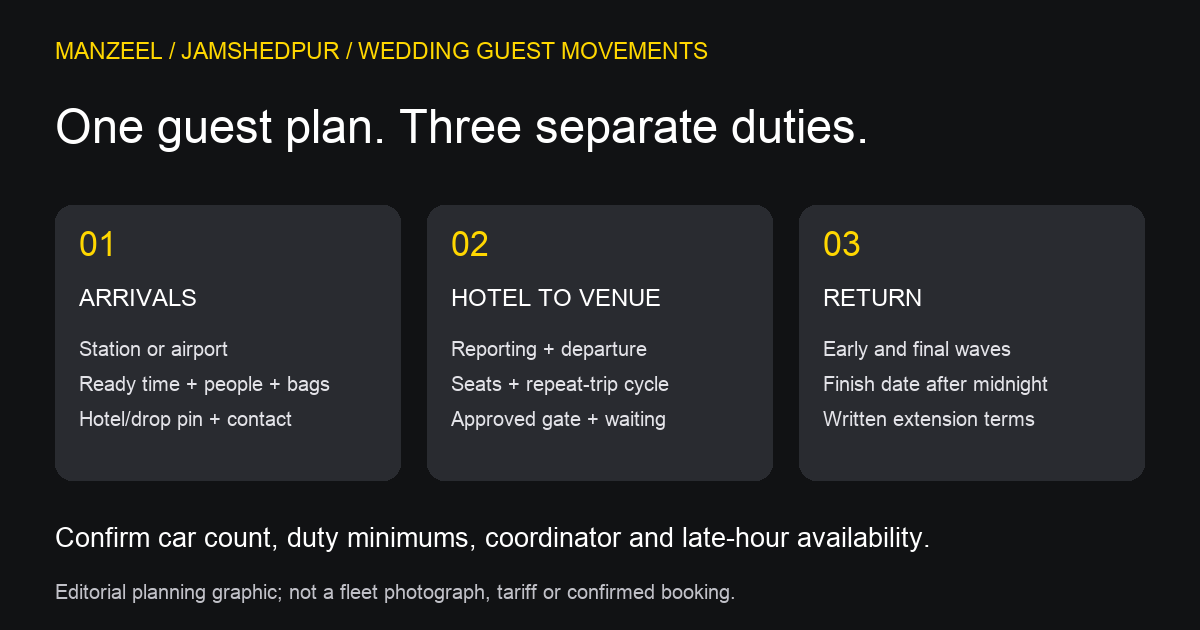
Your booking should describe three movements: guests arriving in the region, guests travelling between accommodation and functions, and guests leaving after the celebration. A station-to-hotel transfer ends at that hotel unless onward use is agreed. It does not automatically include the evening reception, several hotel stops or an airport return two days later.
Keep a dedicated guest-movement list even when a separate decorated car is being considered for the couple. A car committed to an entrance, photographs or vidaai may be unavailable for the next hotel shuttle. Ask which duties can share a car and which must remain separate, rather than giving every relative the same driver number.
Start the enquiry with the actual dates, venues, hotel pins and approximate arrival waves. Then replace estimates with confirmed groups. For one straightforward journey, the online form below can start a cab search. A multi-car or multi-function request needs an itemised operating proposal; one search result does not reserve a fleet or a transport coordinator.
Aapke guests alag trains aur flights se aa rahe hain, to pehle unke pickup groups banaiye. Har group ke liye ek ready time, ek responsible contact aur exact drop likhiye. “Shaadi ke liye gaadi chahiye” se vehicle count, waiting aur late return ka clear quote nahi banega.
How should you compare wedding transport fares in 2026?
Compare complete duties, not just a wedding-car headline. A decorated entrance car, an eight-hour city rental and an airport transfer solve different jobs. Ask for the price per car, the confirmed car count, included hours/km, chargeable reporting location and finish, and every extra. Guest-shuttle coordination and a vehicle held as standby should each have an explicit price or inclusion.
The advertisements below were reviewed on 28 October 2026. They are comparison references, not accepted event quotations or Manzeel tariffs. The first operator publishes differing three-day figures on its page; the second describes décor both as an optional extra and within package inclusions. Those inconsistencies make written clarification essential. Avoid assuming a discount, unlimited waiting or decoration from a starting-price label.
For your own quotation, separate arrival transfers, hotel–venue duty, late return and next-day departure. Record minimum daily billing, extra hour/km, driver allowance, night or midnight treatment, toll, parking, permits, applicable tax, standby and cancellation. Ask who can approve an extension and how it will be documented before a driver continues beyond the agreed duty.
Example only: three cars at a hypothetical ₹3,000 each total ₹9,000 before extras. If each then incurs two hours at a hypothetical ₹250/hour, that adds ₹1,500 across three cars, not ₹500 for the entire fleet. These figures explain multiplication; they are not an advertised Manzeel event package.
| Published source | Advertised basis | What it does not establish |
|---|---|---|
| Jamshedpur to Kolkata Cabs | Guest sedan ₹3,999/car/day for 3+ vehicles; decorated SUV headline ₹5,999/day | Hours/km and extras must match your guest duty; conflicting multi-day figures elsewhere |
| NK Cab & Taxi | Decorated sedan ₹5,000; Crysta ₹8,000, table 8hr/100km | Décor wording conflicts; not a guest-fleet or model availability confirmation |
| RS Travel | Wedding cab headline ₹4,999/day | Exact car, hours/km, late waiting and coordination need a written scope |
| Jamshedpur Cab | City 08hr/80km: Dzire ₹2,200; Ertiga ₹3,000; Crysta ₹4,000 | Driver/toll/parking extra; city rentals are not quoted wedding fleets |
| RUTZ.IN | Wedding/multiple-vehicle duty by individual quotation | National planning reference; no Jamshedpur tariff or local availability verified |
What belongs in a usable guest arrival manifest?
A useful manifest has one row per pickup group or vehicle leg. Include the arrival date in India time, train/flight number where needed, exact station/airport, scheduled arrival, expected ready-to-board time, passenger count including children, bags, hotel/drop pin, group contact and current status. Keep the onward return requirement on the same plan so an arrival booking is not mistaken for a round trip.
Use statuses such as details pending, quoted, accepted, assigned, ready, boarded and dropped. A blank arrival time is not a confirmed pickup. Give each group a simple identifier such as A1 or A2, and version the sheet when a train, hotel or headcount changes. One coordinator should update the master rather than letting several family chats become competing instructions.
Collect only the information needed to move the group. An initial quote usually needs counts and route details, not a public list of full ticket references, passports, hotel room numbers or medical records. Share a group contact with the assigned driver privately after the arrangement is agreed. Describe boarding assistance practically; circulate sensitive information only when necessary and with the guest’s agreement.
The compact template below uses invented group IDs and times solely to show the structure. Replace them with confirmed travel details. A manifest organises work; it does not itself prove that cars, rooms or airport permissions are reserved.
| Group / status | Arrival and ready time | People / bags | Movement and owner |
|---|---|---|---|
| A1 / details pending | Tatanagar, date __; ready __ IST | Adults __; children __; bags __ | Station exit agreed → hotel pin; coordinator __ |
| A2 / quoted | IXR, flight __; ready __ IST | People __; bag sizes __ | Airport permitted meeting point → hotel; owner __ |
| H1 / not assigned | Hotel reporting __; leave __ IST | Confirmed shuttle users __ | Hotel → venue gate; return wave __ |
Can station and airport arrivals share a pickup?
Combine arrivals only when their collection point, practical readiness window, destination and luggage can work together. Two groups reaching Tatanagar around the same time may still exit from different sides or need different hotels. A group waiting for checked bags at Ranchi Airport is not ready merely because its flight has landed. Ask guests whether a shared wait and any intermediate hotel drop are acceptable.
The East Singhbhum district travel page identifies Tatanagar as the city’s rail access and lists Sonari and Birsa Munda Airport, Ranchi, in its air-access description. It is orientation, not a live flight timetable or a measured hotel route. Use the airport actually shown on the guest’s booking; do not promise a Sonari flight connection without checking the airline.
For rail arrivals, use the Tatanagar station cab guide, confirm the station arrival date and agreed exit/vehicle meeting point, and allow time for bags and walking. For IXR, use the Ranchi Airport to Jamshedpur guide, confirm terminal-side instructions and waiting terms, and build a separate intercity journey into the schedule.
A Ranchi Airport transfer can occupy a car for a substantial part of the event day; do not also count it as instantly available for a city hotel shuttle. If Kolkata Airport is the chosen arrival, quote that longer corridor separately. When a flight/train is delayed, tell the coordinator who decides whether to hold the group, split it, send another car or revise the next duty.
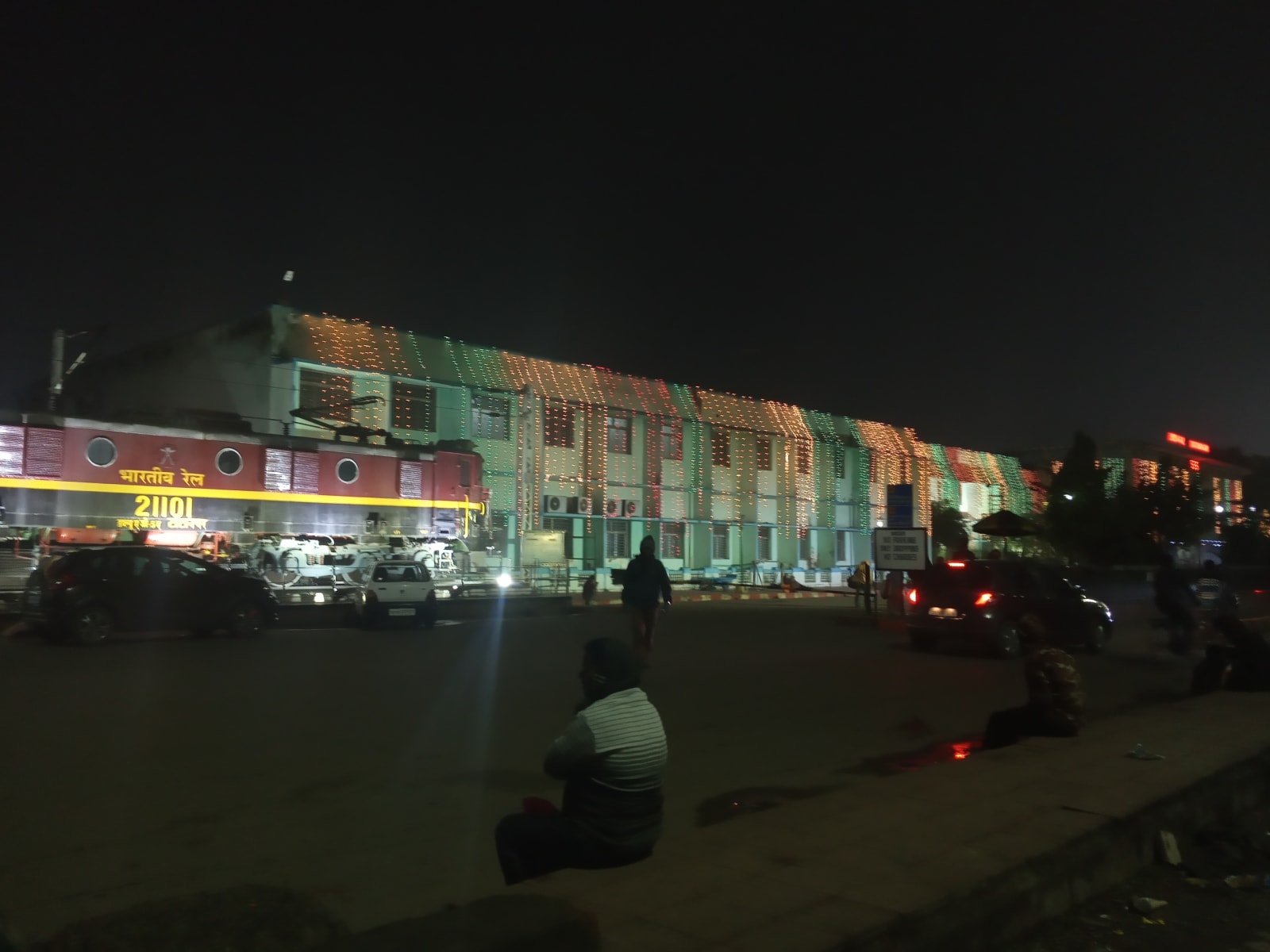
Station-area orientation only: not a confirmed car meeting point, hotel or wedding venue.
Replace sample endpoints with the actual hotel, permitted pickup and venue gate. No venue partnership or measured trip time is implied.
How should hotel-to-venue transfers be scheduled?
Work backwards from when guests need to be at the venue, then allow for unloading, driving, loading and any hotel assembly time. “Function starts at 7” is not a vehicle reporting instruction. Separate the car’s reporting time, guest lobby-ready time, departure and latest acceptable arrival. Give guests the departure time they must meet, not the later ceremony time.
For hotels in Bistupur, Sakchi, Sonari, Kadma, Mango or Adityapur, use exact pins and the venue’s approved gate. These are planning localities, not a promise that all fall inside one tariff boundary. An Adityapur venue or a distant banquet approach may change the route, operating duty and return cycle. Ask the venue about vehicle entry, turn-around, unloading and parking before fixing shuttle intervals.
Group people by hotel and movement window, then check whether each car must return empty to collect another wave. Loading, family photographs, mobility needs, gate queues and traffic consume time even on a short map route. Record the next reporting time only after the previous duty can finish. A car cannot be allocated to two simultaneous hotels simply because both trips are described as local.
Confirm both directions of every function. An early return for guests who need to leave before the final reception pickup can use a separate quoted car or a feasible earlier wave. Communicate the last planned departure clearly and name the contact for changes; do not leave guests believing that cars will circulate indefinitely.
How many cars or repeat trips fit your transfer window?
The planning tool below checks one simplified hotel-to-venue movement with identical cars, one origin, one destination and everybody ready at the start. Enter confirmed usable passenger places after the driver and any luggage arrangement. Do not divide the wedding’s entire invitation count by a “seven-seater” label; count the people who need this particular movement.
With hypothetical inputs of 24 guests, six usable places per car and two cars, each wave moves 12 people. A 20-minute drive, ten-minute boarding, five-minute unloading and ten-minute turnaround buffer give the first arrival after 35 minutes and a repeat cycle of 65 minutes. The second wave therefore finishes at minute 100. It cannot deliver all 24 inside a 60-minute window.
The same assumptions give capacity for only one wave in that window, so the arithmetic needs four identical cars to move 24 people together. This is a seat-and-time estimate, not proof that four cars are available or that six people and their bags fit a specific model. Increasing the window, changing the route or using a verified larger vehicle changes the plan.
The tool assumes equal drive times outbound and empty return. It excludes staggered arrivals, multiple hotels, driver shifts, rests, gate closures and real-time traffic. Use separate calculations for different movements, then have the operator validate the complete run sheet. The number of return trips after the function is a separate question.
Check one hotel-to-venue shuttle window
Hypothetical defaults, not a vehicle reservation. Everyone is ready at the start; identical cars share one origin/destination and equal outward/empty-return driving time. Usable seats must already account for driver and bags.
Entered fleet capacity within the window: 12 passenger places. Short by 12 places. Last needed arrival with these cars: minute 100.
Arithmetic minimum: 4 identical cars under these assumptions; confirm supply and suitability separately.
This checks one simplified movement only. It does not establish vehicle/bag fit, driver duty/rest, multiple hotels, staggered arrivals, traffic, pricing or availability.
Which vehicles suit wedding guests and their luggage?
Choose cars using the people, their bags and boarding needs for each leg. Airport arrivals carrying large cases need a different loading plan from guests already checked into a hotel and carrying small day bags. Every traveller, including a child, needs an appropriate usable passenger position. Ask about child restraints, assistance and luggage dimensions before assigning the group.
The Ertiga versus Innova family guide explains driver-excluded seating and why the occupied rows matter. Specify the Innova generation/variant rather than assuming every Innova has the same seats or boot. Ask for recent cabin/boot photos of the proposed car and confirm which seats remain available when bags are loaded.
If the group needs more seats, ask whether a suitably configured larger vehicle can be quoted for that date and route. Do not assume a Tempo Traveller, coach, matching car convoy, wheelchair-accessible vehicle or a particular luxury model is available from Manzeel. Confirm the actual category, passenger capacity, loading arrangement and venue approach before offering it to guests.
A small separate transfer may suit a family that needs earlier arrival or easier boarding. Keep that decision in the manifest so it does not quietly reduce the seats assigned to the main wave. The city and station images in this guide are historical location references, not photographs of an assigned Manzeel wedding fleet.
How should waiting, late returns and midnight duties be quoted?
Waiting needs a written start point and allowance. Ask whether the clock starts at vehicle reporting, the scheduled train/flight arrival, actual collection, or the garage. Confirm any included waiting, excess hourly rate, kilometre minimum, rounding and parking. A vehicle sitting outside a ceremony may still be on a chargeable duty even while nobody is travelling.
For a function expected to finish after midnight, write the complete finish date and time. “Saturday night” can mean early Sunday to the driver. Ask whether crossing midnight starts another billing day, adds a night allowance or changes driver arrangements. Do not infer the answer from a generic 24/7 contact number or an ordinary eight-hour city package.
Decide whether the cars remain available throughout the function or leave and return at accepted reporting times. Retention can preserve flexibility but uses duty hours; a separate return needs its own accepted vehicle and pickup plan. Neither arrangement includes unlimited changes. Ask how a delayed vidaai affects the last guest wave and who approves the additional cost.
Include driver breaks, meals/stay where relevant and an agreed operating plan for extended duty. Do not build an overnight timetable around one driver working continuously. If guests miss the final departure, the coordinator needs a separately confirmed option and cost approval process rather than an assumed free extra trip.
How can several cars be coordinated without conflicting instructions?
Use one transport lead and a backup from the host/planner side. Ask Manzeel who will handle vehicle assignment and event-day changes, whether on-site coordination is offered, and what it costs. Fleet coordination, standby replacement and late-hour availability have not been verified for this guide, so treat them as items to confirm in the proposal.
Give each accepted vehicle a movement ID, reporting pin/time, permitted destination gate, assigned group and next task. Verify driver and vehicle details when shared, and pass the relevant details to that group. At boarding, the host-side contact should reconcile people and bags against the list. At drop, mark the leg complete before releasing the car to another task.
Agree a disruption rule: who is called if an arrival is delayed, a vehicle changes, a guest cannot be found or the venue gate closes? Ask about response expectations and replacement arrangements, but do not describe backup vehicles as guaranteed unless the booking actually provides them. Keep the driver free to drive; route coordination through the named contact.
Send guests a short movement message with date, hotel assembly point, lobby-ready time, vehicle contact when assigned, destination and return arrangement. Share only their own group’s information. A calm, consistent update is more useful than sending the full private manifest to every guest and driver.
Is wedding-car decoration part of guest transport?
Decoration should be a separate enquiry unless explicitly accepted with the relevant car and duty. This guide does not confirm that Manzeel currently offers decoration, a decorator, a trial design or a particular decorated vehicle in Jamshedpur. Existing promotional pages alone do not establish date-specific service, inclusions or fleet supply.
If offered, ask for the exact car, decoration scope, material/theme, installation and removal time, permission, cost and any refresh between functions. Clarify whether that vehicle is reserved for the couple or can also carry guests. The decoration appointment and photography time must appear in its run sheet; they cannot overlap a promised station pickup.
Keep flower/design preferences separate from passenger and luggage capacity. Do not plan arrangements that obstruct visibility, lights, number plates, doors or access. Venue procession, road access, photography and parking permissions need their own confirmations; hiring a cab does not automatically obtain them. The guest-movement quote should remain understandable even if the decoration request is declined.
What should you send to get a workable quotation?
Send event dates, each arrival point and readiness window, hotels, venue gates, group sizes, bags, requested car categories and planned return departures. Mention whether cars wait, whether a separate late wave is needed, and whether a coordinator or standby car is being requested. Use counts and group IDs in the initial enquiry, then share necessary contact details privately after the scope is agreed.
Ask for a car-by-car and day-by-day proposal: reporting and release points/times, duty minimum, hours/km, driver/parking/toll/permit/tax, waiting, night/stay, model substitution, payment stages and cancellation. Have vehicle count and assignment timing acknowledged. Repeated individual online searches are not an accepted multi-car reservation.
Before the event, reconcile confirmed arrivals and shuttle users, check the venue approach, and circulate the approved run sheet. An editorial review sequence is: confirm the broad scope when dates are fixed, reconcile details as guests book, review changes a few days before, and recheck the assignment before each movement. These are planning steps, not a universal supplier deadline or guarantee.
For one leg use the booking controls on this page and review the selected journey on results. For the full event use the topic-specific WhatsApp enquiry or call +917209012333. No transport has been reserved by filling the planning worksheet, selecting a duty example or drafting the enquiry.
What evidence supports this guide, and what still needs confirmation?
The Manzeel Editorial Team reviewed five operator/transport pages, wedding-planning material, the district travel reference and public discussions on 28 October 2026. Day 28 is the content-plan slot for 29 October; the research date shown here is the actual review date. Exact-keyword volume/KD and genuine Manzeel customer enquiries were not available for this topic.
WeddingWire’s transport guidance and RUTZ.IN’s wedding service page describe transport scope and coordination; their terms are not adopted as Manzeel policy. A shuttle-demand discussion and a return-transport discussion raise RSVP, early departure and return-planning questions. These are other people’s experiences in other places, not verified Jamshedpur operating conditions.
Current event fleet, minimum duties, late-hour availability, coordination, decoration and final fare remain subject to written operational confirmation. The original shuttle calculation uses stated hypothetical assumptions. Historical photographs and a map give location context; they do not prove current gates, fleet ownership, venue partnerships or an on-site survey.
About this guide
Manzeel Editorial Team reviewed event/transport pages, district travel information and public planning discussions. Photos show historical location context. Current event supply, decoration and final quotations require confirmation.
Jamshedpur wedding guest transport — FAQs
Can several guest pickups be combined?
How is wedding transport waiting charged?
Can we reserve multiple cars for the wedding?
Is car decoration available separately?
Can one car handle Ranchi Airport pickup and hotel shuttles?
How many cars do we need for 24 guests?
What if the reception ends after midnight?
Should senior guests use a separate return?
What guest information should we share with drivers?
Does the online form book the complete wedding transport plan?
Guest list se clear movement plan — phir written quote.
Event dates, pickup groups, hotels, venues, people, bags and return waves — request a complete proposal.